During most of the human history gold was the only thing that had more-or-less internationally recognized value. The second-worst energy-wasting computer thingy, bitcoin, is a recent invention, and United States only become a problem outside of their hemisphere after the previous world war, World War 2, ended, and before that, it was all gold (OK, pound sterling was also kinda important, but it also was a function of Great Britain trying to have the Gold Standard).
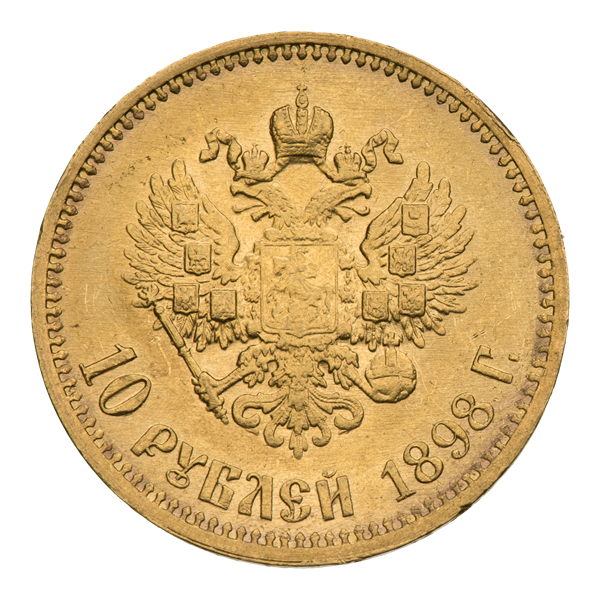
Russia was not an exception and tried to have gold-backed currency too (gold standard was pretty shaky in practice for lots of reasons, starting from smartassy ones like "tying up the money supply to an irrelevant value like scarcity of certain shiny metal is stupid" and ending with easily demonstrable ones: find a golden coin in a modern world, check out how much does it cost relative to its size, and imagine having to use it to actually pay for goods and services), and before the great socioeconomic reset of 1917, there existed a 10-ruble golden coin named "Chervonetz" for the reasons too boring to explain to a non-Slavic-language speaker, which was reasonably respectable outside of the country and which was actually used for the foreign trade.
As stated above, it doesn't mean that these 10 rubles were the same 10 rubles as were paid in paper money for the most of the time of existence of this coin, but it's beside the point.
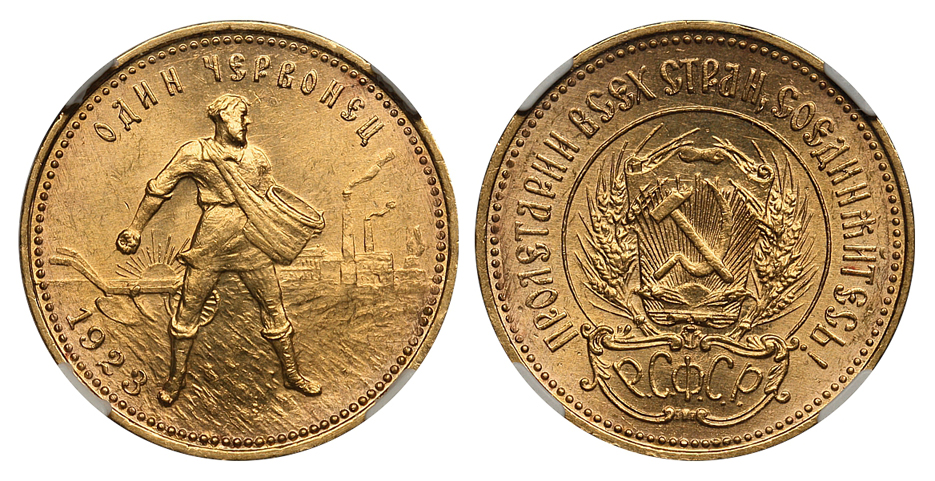
When bolsheviks came to power, the communist revolution stalled in Russia itself and was not exported, which meant that foreign trade was still to be done in gold. Since the tsar-era chervonetz coin was already well-known, a new coin of the same size and composition was made and was even used for foreign trade for a year or two, until the concept of the foreign trade and currency policy was changed. Not that many of these coins still exist, since large amounts of them were melted down. The memory remained though.
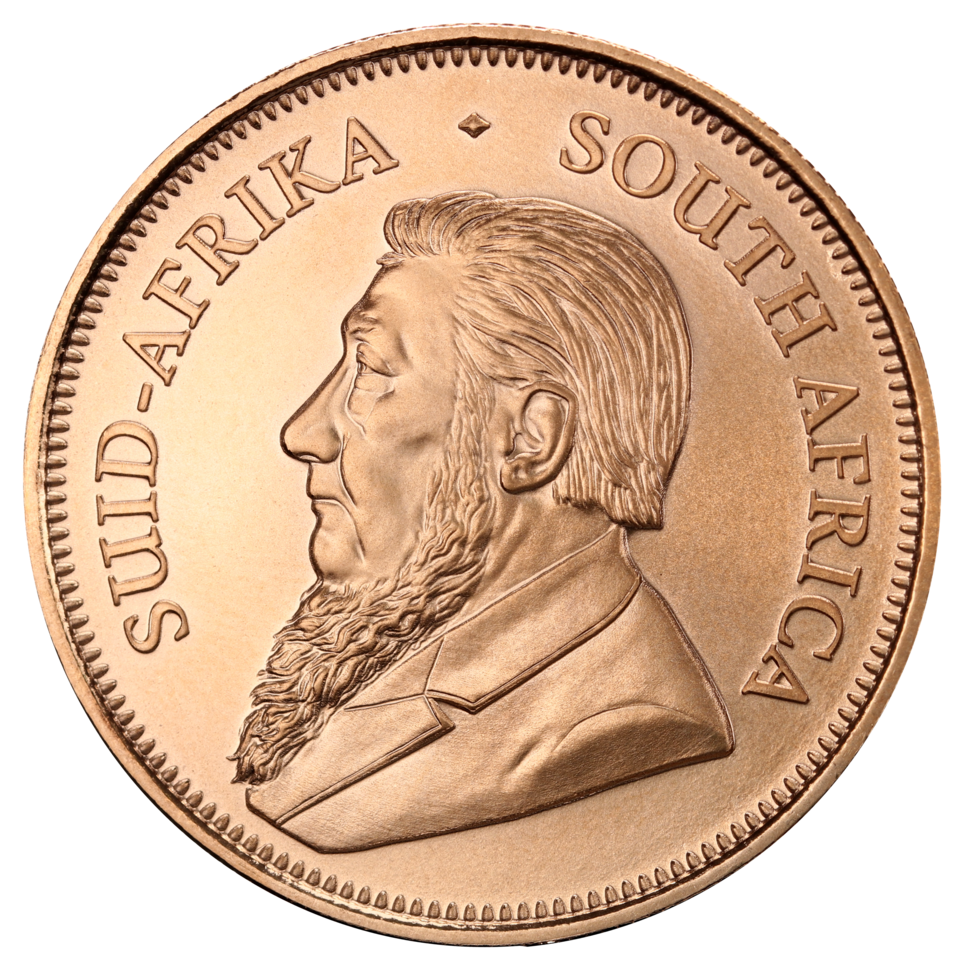
After the World War 2 US dollar became the de-facto world currency, but gold remained a valuable commodity and still is. In the US itself, however, between 1934 and 1975 private ownership of gold was heavily restricted, with only small amount of gold coins being allowed to be owned, but not gold bars.
Meanwhile, though nazis were temporary defeated in Germany, a country with similar ideas continued to exist - South Africa. Unfortunately there was never a mechanism preventing it from exporting horrible men with non-functional penises and bad taste in car design, but fortunately, its gold exports were sanctioned.
Two facts from above led to creation of the modern idea of investment coin, or bullion coin - an object which value is mostly defined by its gold content (not rarity or similar factors), but which, for mostly legal reasons, has a face value in some currency and can technically be used as such (though such value is always hilariously low in comparison to its gold content), first of which was the South African Krugerrand, invented purely to allow Americans to privately own a little bit of that sweet-sweet Apartheid gold. Holiday on other people's misery!
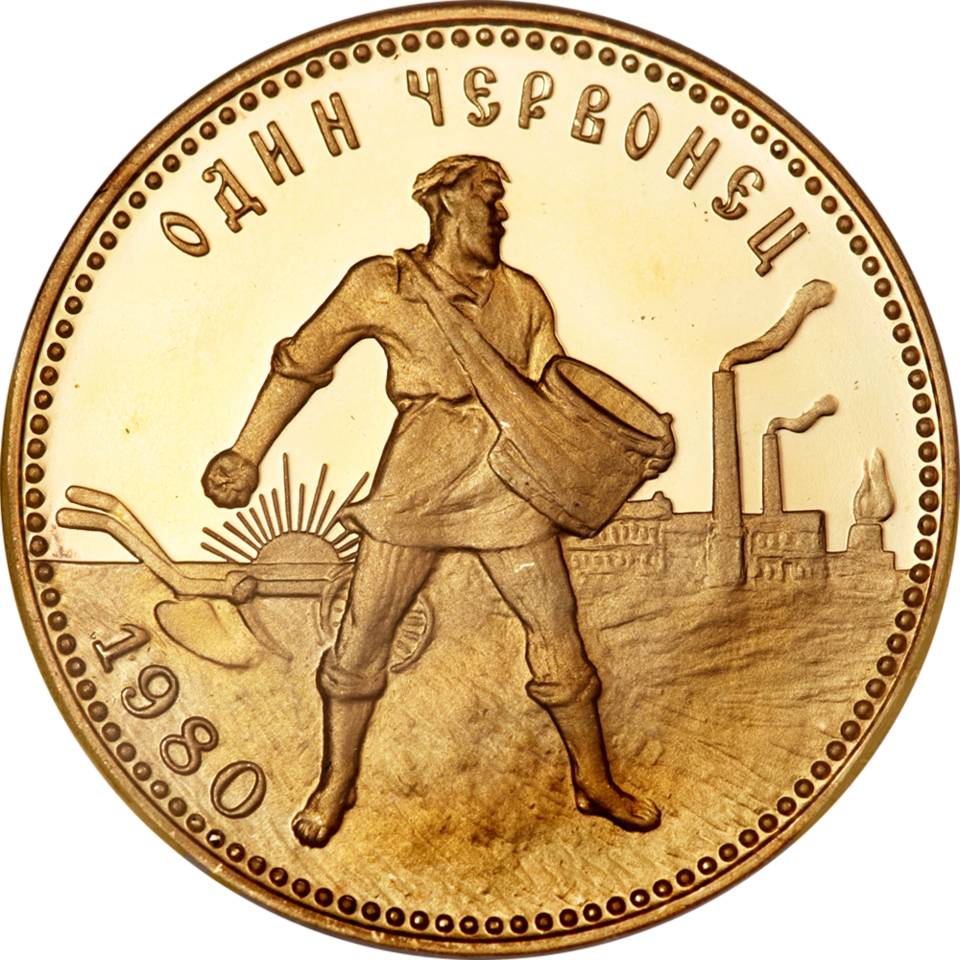
Soviets jumped the hype train too. In 1975 they pulled the documentation for 1923 Chervonetz coin from the archives, and started making new ones, producing quite a lot of them between 1975 and 1982 (modern Russia also did it in 2023, but it's another story, if a story at all).
These coins were and are the investment coins as we know them today - mostly gold, a little diluted to make them more practical to handle (pure gold is very, very soft and easy to damage), as valuable as its gold content. You can buy one now and quickly learn why gold coins were never used as liberally as one can think after playing too much medieval-themed video games (or Fallout 2/New Vegas) - it's a pretty small thingy, but as of writing of this post, costs over a thousand euros.
At this point the part of the story easily sourceable from English-speaking internet is over and the short, but fun part is coming.
According to Russian-speaking online sources (like banki.ru and numismatic forums) there exists a certain non-negligible amount of 1975-1982 Chervonetz coins which are legally fake, but physically legit.
Let me explain.
As I said, the whole point of an investment coin is to be as valuable as its gold content to allow its owner to get around certain regulations, like US executive order 6102, or Russian rule forcing the banks to apply VAT while selling gold bars but not gold coins. If you want, you can resell your gold coin not to a collector, but to a goldsmith to be used in jewelry, and you won't lose too much money on it, and it's the whole point.
Legally though, investment coin is still a coin, and it's expected to adhere to a standard for this coin, which describes how it looks like and what is it made from except for gold.
And some 1975-1982 Chervonetz coins held by people in, at the very least, Russia (I'm not aware of such cases outside of it), while having the correct gold content, are obviously fake, with errors in the picture on it, and with wrong non-gold content.
There are kinda-documented cases of Russian banks happily selling such coins to the public and refusing to buy it back.
The only way to get back any money from it is to pretend to not know anything and sell it to a goldsmith because these coins are still considered legal tender in Russia, and selling or buying fake currency is illegal, though some collectors are really eager to get a hold of one.
The question remains of why do these coins even exist, and the only explanation I'm aware of is that it was an attempt to launder illegally mined gold during Soviet era, sold to Sberbank offices at the time, probably with some element of corruption, and ending up in circulation this way.
Whether it's true or not is what we will never know, because people who did it certainly didn't have their own secret online forums.